Since its creation, Rubis has worked to limit the environmental impact of its activities. With this in mind, we roll out initiatives tailored to local realities in order to protect and preserve ecosystems. Because it also contributes to the efficiency and reliability of our operations, we see this approach as a driver of overall performance.
Our commitments
Rooted in the reality of our operations, our approach focuses on our most significant environmental impacts. Our objectives are:
Reduce our environmental footprint
Manage our impacts on biodiversity
Develop our photovoltaic capacity while preserving local areas
Reduce our environmental footprint
Rigorous measures are in place to strengthen the control of accidental spill risks. This commitment is a driver of operational excellence for our teams.
Our target:
-10%
in accidental spill rates
Our target
- 10%
in accidental spill rates
Accidental spills
Of more than 200 litres reaching the environment, per million m³ of products distributed.
2023–2025 average
2.2
2030 target
1.9
Manage our impacts on biodiversity
To minimise our biodiversity footprint, we pay particular attention to our facilities located near sensitive areas. Our approach is based on assessing our local impacts and deploying measures to avoid, reduce or offset them, in line with the specific challenges of each ecosystem.
By 2030, we are committed to conducting a biodiversity assessment at all our industrial sites and solar farms of more than 1 MWp located near a biodiversity-sensitive area, and to implementing appropriate action plans. This approach helps secure the resilience of our activities through better control of our environmental footprint.
This approach helps secure the resilience of our operations through better control of our environmental footprint.
Our target:
100%
of sites located near biodiversity-sensitive areas carry out an assessment and deploy an associated action plan
Our target
100%
of sites located near biodiversity-sensitive areas carry out an assessment and deploy an associated action plan
Develop our photovoltaic capacity while preserving local areas
We foster shared value creation with our stakeholders in the areas where we develop our photovoltaic capacity, limiting conflicts of use — notably through the use of brownfield sites — and prioritising joint activity, whether agricultural, industrial or tertiary.
By 2030, at least 50% of Rubis Photosol’s photovoltaic capacity will be jointly operated, both by our teams and by a local economic or public stakeholder.
Our target
≥ 50%
of Rubis Photosol’s photovoltaic capacity operated in joint agricultural, industrial or tertiary activity
Our target:
≥ 50%
of Rubis Photosol’s photovoltaic capacity operated in joint agricultural, industrial or tertiary activity
Zoom on…
The Jarry depot in Guadeloupe
In Guadeloupe, we carried out a biodiversity assessment at the Jarry depot, located close to coastal wetlands and sensitive natural areas.
Conducted by ecologists, this assessment enabled us to identify measures suited to local ecosystems, such as creating vegetation islands to limit soil sealing and installing nesting boxes to protect local biodiversity.
The Verneuil solar farm in France
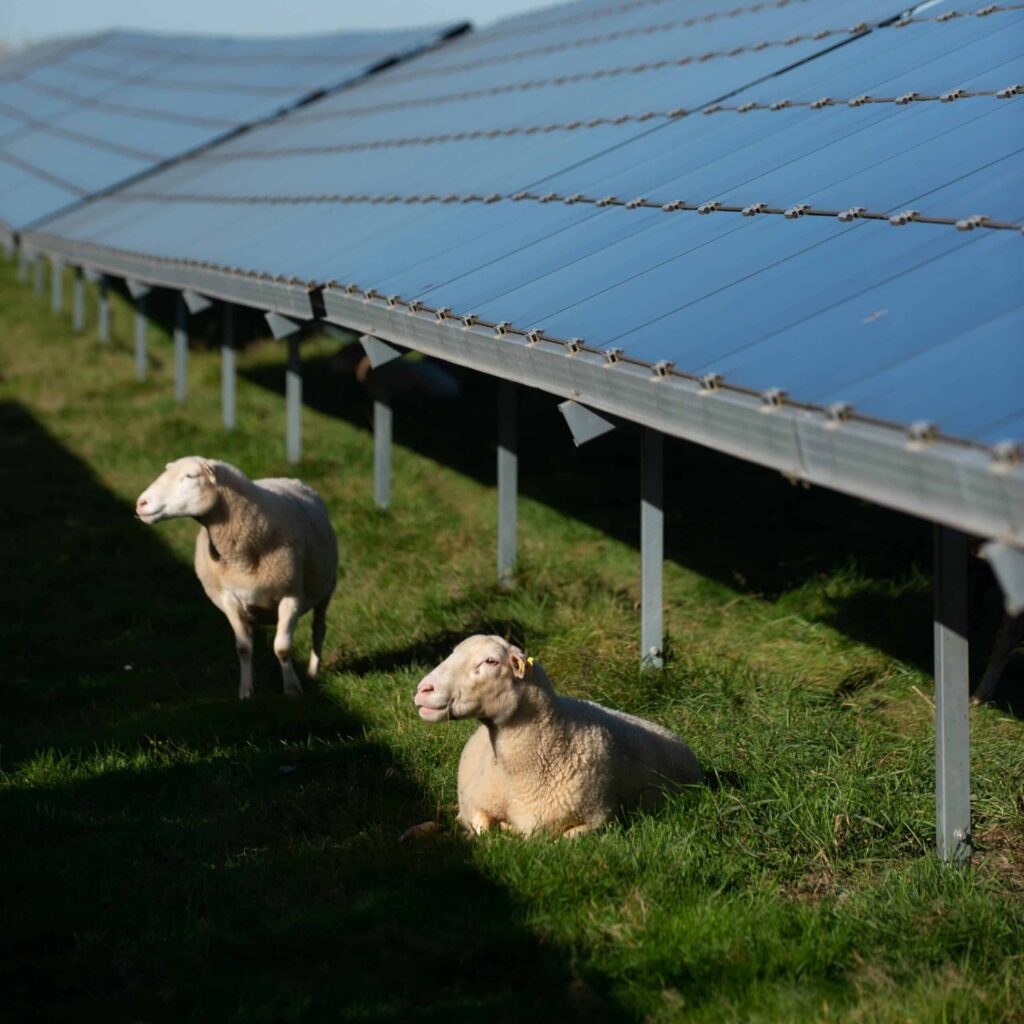
Spanning 70 hectares, the Verneuil solar farm has demonstrated for the past seven years how renewable energy generation and livestock farming complement one another.
A study by INRAE (France’s National Research Institute for Agriculture, Food and Environment), carried out in partnership with Rubis Photosol between 2020 and 2022, confirms the benefits of this joint activity: it provides protection against climate hazards such as drought and supports healthy grass growth. The site’s landscape integration, reinforced by 1,800 metres of hedgerows, also helps promote biodiversity and territorial balance.
Rubis SCA (hereinafter referred to as “Rubis”) attaches great importance to the protection of your personal data (hereinafter referred to as “Personal Data”), which refers to any information relating to an individual, provided voluntarily by them or collected as part of their browsing on the website www.rubis.fr (hereinafter referred to as “the Website”). The purpose of this notice is to describe how Rubis processes Personal Data collected when you use the www.rubis.fr website and to inform you of your rights under data protection regulations.
1. Purpose of collecting Personal Data and retention period
Financial communications mailing list Rubis collects Personal Data (gender, surname, first name, email address, country of residence, language) via the online form that allows you to subscribe to its financial communications email list. The Personal Data collected is kept for as long as you are subscribed to this mailing list and is archived in accordance with current regulations. You can unsubscribe from the financial communications mailing list by clicking on the dedicated hypertext link at the end of the e-mails.
Cookies In order to offer you a better service, Rubis compiles statistics and measures the audience for the Website. To enable statistical analysis, the Website provider uses the services of etracker GmbH, which installs cookies (small text files stored by the Internet browser on the user’s device). Data generated with etracker GmbH is processed and stored exclusively by etracker GmbH. It is processed in accordance with Article 6 of the General Data Protection Regulation. A window is automatically displayed when you first log on to the Site detailing the types of cookies installed and allowing you to select those whose use you accept. Please note that cookies may be stored temporarily (for as long as your web browsing session is open), or may have a longer lifespan, depending on their settings and those of your web browser. You may refuse to accept cookies (although their non-installation may limit certain functions of the Site). The configuration of browsing tools for this purpose is described by the Commission Nationale de l’Informatique et des Libertés (CNIL), at the following address (french only): https://www.cnil.fr/fr/cookies-et-autres-traceurs/comment-se-proteger/maitriser-votre-navigateur
2. Recipients of Personal Data
The Personal Data collected is processed by Rubis or, where applicable, by a service provider bound by contract to respect its confidentiality and security and to use it only for the purposes of the task entrusted to it. Rubis undertakes not to sell, rent or transfer it to third parties.
3. Storage and hosting of Personal Data
Personal Data collected by Rubis is stored and hosted on secure servers located in the European Union.
4. Security of Personal Data
Rubis implements appropriate measures to preserve the security, confidentiality and integrity of Personal Data, in particular to prevent it from being distorted, damaged or accessed by unauthorised third parties.
5. Enforceable rights with regard to the protection of Personal Data
The regulations give you the following rights with regard to your Personal Data:
a right of access, rectification and deletion;
the right to object to or limit the collection of personal data;
a right to portability ;
the right to determine what happens to your data after your death;
the right to lodge a complaint with a supervisory authority.
Cassin1 Datacenter, Futuroscope – 86360 Chasseneuil-du-Poitou, France
PURPOSE OF THE WEBSITE AND UPDATES
The purpose of the www.rubis.fr website is to provide all interested parties (hereinafter referred to as “users”) with information on the activities and results of the Company and the companies it directly or indirectly controls within the meaning of French law. The website, including this legal notice, may be updated at any time.
Users can access information available on the website via an RSS feed. The use of this right is granted by the Company for individual and non-commercial purposes only, provided that the website URL is clearly mentioned.
PROTECTION OF PERSONAL DATA AND COOKIES
Rubis may need to collect your personal data in order to respond to a request from you. This data is processed by Rubis or, where applicable, by a service provider bound by contract to respect its confidentiality and security and to use it only for the purposes of the assignment entrusted to it. Rubis undertakes not to sell, rent or transfer it to third parties.
In accordance with current regulations, you have the right to access, rectify, delete and object to your personal data.
In order to offer you a better service, Rubis compiles statistics and measures the audience for the Website. To enable statistical analysis, the Website provider uses the services of etracker GmbH, which installs cookies (small text files stored by the Internet browser on the user’s device). Data generated with etracker GmbH is processed and stored exclusively by etracker GmbH. Data is processed in accordance with Article 6 of the General Data Protection Regulation.
We inform you so that you may refuse to accept these cookies. However, the non-installation of a cookie may limit certain functions of the Site. The configuration of the navigation tools is described at https://www.cnil.fr/fr/cookies-les-outils-pour-les-maitriser .
WARNING
The Company declines all responsibility:
in the event of imprecision, inaccuracy or omission concerning information or documents available on the website, including computer links (hypertext links, etc.) used by or referring to the website;
in the event of direct or indirect damage, whatever the causes, origins, nature or consequences, resulting from access to the website or the impossibility of accessing it, from its use or from the credit given to any information or document originating directly or indirectly from the website (these in no way constituting an invitation to invest, a form of canvassing or a public offer of financial instruments).